The trailer carries the freight, takes the weight, and triggers most of the fines, yet weighing attention has always gone to the tractor. Trailer scales fix that imbalance. This guide covers everything an operator needs to know about weighing trailers on air suspension: how onboard trailer scales work, what they cost against the alternatives, how drop and hook changes the design requirements, and how to get one fitted. For the short version and specifications, our trailer scales product page has the summary; this is the long read behind it.
Why the trailer is where weighing matters most
Three facts put the trailer at the centre of compliance. First, the trailer axle groups carry the majority of the payload, so they reach their limits first. Second, load position inside the trailer decides the split between the trailer group and the tractor drives through the kingpin, which means the trailer is where balance is won or lost, as our reefer weight distribution guide shows in detail. Third, in drop and hook operations the trailer is the unknown: the tractor’s tare never changes, but every trailer arrives with its own history. A scale that lives on the trailer answers all three.
The types of trailer scales, honestly compared
- Air suspension trailer scales (the AirRide Scale category) read the pressure in the trailer’s air bags per axle group. Cost effective, wireless, fast to retrofit, and accurate when calibrated. The requirement: the trailer groups must ride on air.
- Load cell systems weigh between the trailer chassis and body. Highest precision, highest price, significant installation, best where payload is invoiced by weight.
- Portable pad scales under the trailer wheels work for spot checks but demand level ground, setup time, and a stopped vehicle for every reading.
- The weighbridge remains the certified reference and the ideal calibration source, but it is fixed, queued and after the fact. The full technology comparison is in our accuracy comparison guide.
How an air suspension trailer scale works
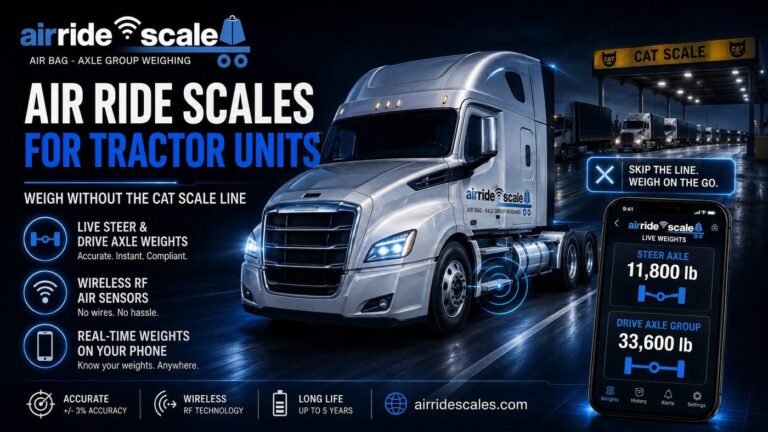
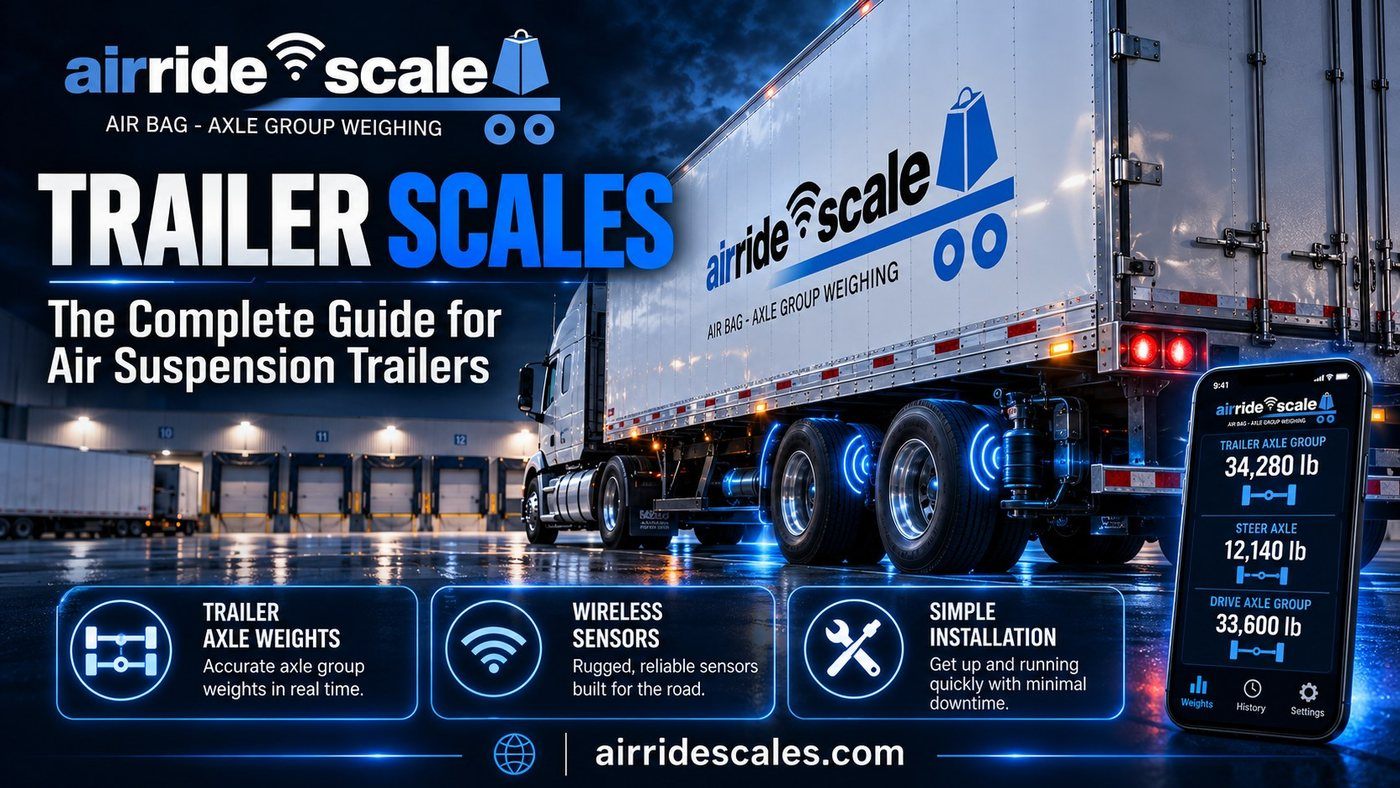
Wireless RF sensors mount at each air bag position on the trailer axle groups and read suspension pressure continuously. They transmit to the AirRide Air Link hub, which also gathers the tractor sensors if fitted, applies each group’s calibration, and sends live weights to the mobile app by Bluetooth. The driver or loader watches the trailer group climb pallet by pallet, alongside the drives and steer, with gross weight and legal status in the same view. Weights display in pounds or kilograms, which matters for cross border work between the USA and Canada or across European borders.
The loading dock advantage: a trailer scale converts every dock into a weigh station. Distribution problems get fixed while the forklift is still in the trailer, instead of discovered thirty miles later at a scale house with the doors sealed.
Drop and hook: the design requirement that separates systems
Fleets that swap trailers all day need the scale to belong to the trailer, not the driver or the tractor. AirRide Scale is built that way: sensors stay on the trailer, the calibration is stored, and whichever tractor hooks up, the trailer group reads true the moment the app connects. One Air Link manages the whole combination with up to 16 sensors, covering multi axle trailers, B doubles and road trains. For refrigerated fleets, the same architecture handles the extra variables of reefer work, fuel burn on the nose, washout water, multi stop weight shift, covered in our guides to reefer trailer scales and multi stop routes.
Accuracy, calibration and care
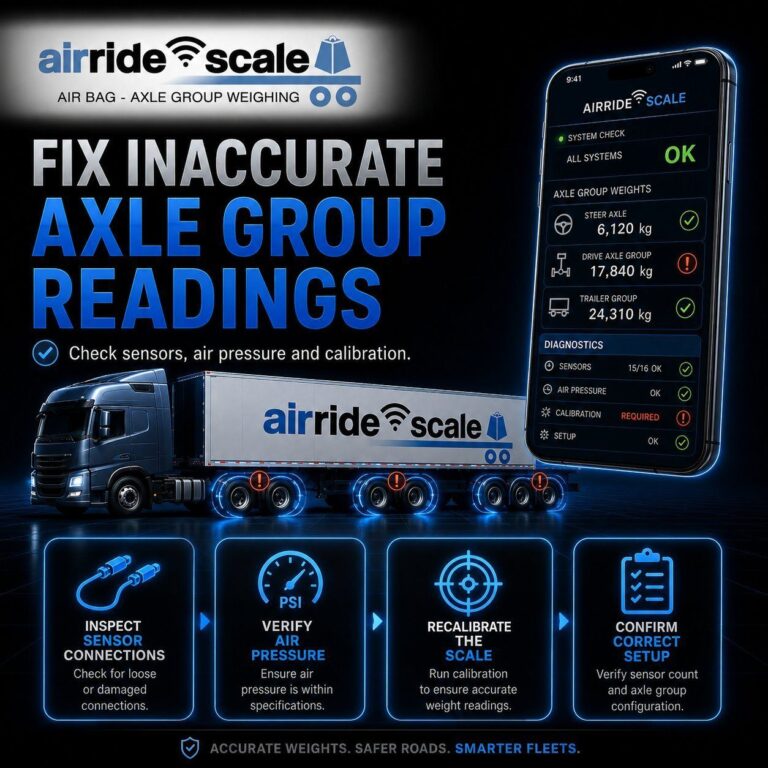
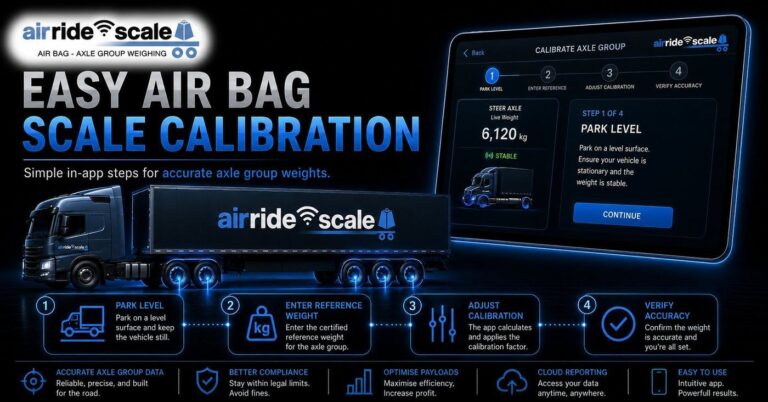
A trailer scale is only as good as its calibration and its air system. Calibrate each trailer group against a certified weighbridge weight, on level ground, with the suspension settled. Keep the air circuit healthy: a leaking bag or a lazy levelling valve shows up as a low or unstable group reading long before it becomes a suspension problem, which makes the scale a free early warning system. Recalibrate after air bag replacement or suspension work. With those habits, operators load to the legal limit with confidence, trip after trip. The calibration guide and reset guide cover the procedures.
The cost case
Price a trailer scale against what the absence of one costs. Public scale tickets at 13 to 15 dollars a weigh in the USA and similar in the UK and Europe, detour miles, queue time, the occasional restack, and the tail risk of an overweight citation with an out of service order. For trailers that weigh weekly, the system typically pays back inside the first year, and faster for reefers and bulk trailers that weigh more often. The full arithmetic is in the cost comparison.
Air suspension only. AirRide trailer scales weigh through the air springs, so each trailer axle group you want to weigh must ride on air bag suspension. Most modern trailers in the USA, UK and Europe qualify; spring ride groups are not supported.
Installation and getting started
Fitting is a same day retrofit per trailer: sensors at each air bag, air lines connected cleanly, the Air Link powered, then calibration in the app. The sensor installation guide walks through it, and because the system is modular you can pilot one trailer before committing the fleet.
Trailer scales and the people around the trailer
One underrated benefit: a trailer scale changes conversations, not just numbers. Loaders at a busy dock get a live target instead of a guess, so the load is built right the first time rather than argued about afterwards. Shippers who push for two more pallets meet a time stamped reading instead of a driver’s instinct, which ends the negotiation politely and in writing. Receivers disputing a short delivery can be answered with the weight that left the dock. And for fleet managers, the optional cloud portal turns every trailer into a reporting point, so the one unit loaded wrong this morning is visible before it leaves the yard. None of this appears on a specification sheet, but operators who run trailer scales for a season describe these moments, the avoided arguments and the settled disputes, as the benefit they would least like to give back.
The bottom line: the trailer is where the weight lives, so the trailer is where the scale belongs. An air suspension trailer scale from AirRide gives every trailer its own live, wireless weighing system for a fraction of the alternatives. Ask us about your trailers.