An onboard scale is exactly what the name promises: a weighing system that travels on the vehicle, measuring the load from the inside instead of waiting for a weighbridge to measure it from below. For trucks and trailers, that single change of location transforms weighing from an errand into a glance. This guide covers the essentials: what an onboard scale is, the technologies behind the term, where the accuracy comes from, what the systems cost against the habit they replace, and how to choose one that fits your fleet in the USA, Canada, the UK or Europe.
What counts as an onboard scale?
Any system that produces a weight reading from sensors mounted on the vehicle qualifies, and three families dominate. Load cell systems place strain sensors between the chassis and the body or fifth wheel, delivering the highest precision at the highest cost and installation effort, and earning their keep where payload is billed by the tonne. Drive axle and mechanical deflection systems estimate from component strain and suit specific vocational setups. Air suspension systems, the family AirRide Scale belongs to, read the pressure in the air bags of air ride suspension, converting it through calibration into per axle group weights. For the majority of highway tractors and trailers, which already ride on air, the third family offers the best accuracy per dollar by a wide margin, and our guide to how air bag scales work explains the mechanism.
The anatomy of a modern onboard scale
- Sensors at each measuring point, wireless RF in AirRide’s case, mounted at the air bags of every axle group you want to weigh.
- A hub, the AirRide Air Link, that collects all sensors across tractor and trailer, holds the calibrations, and relays results.
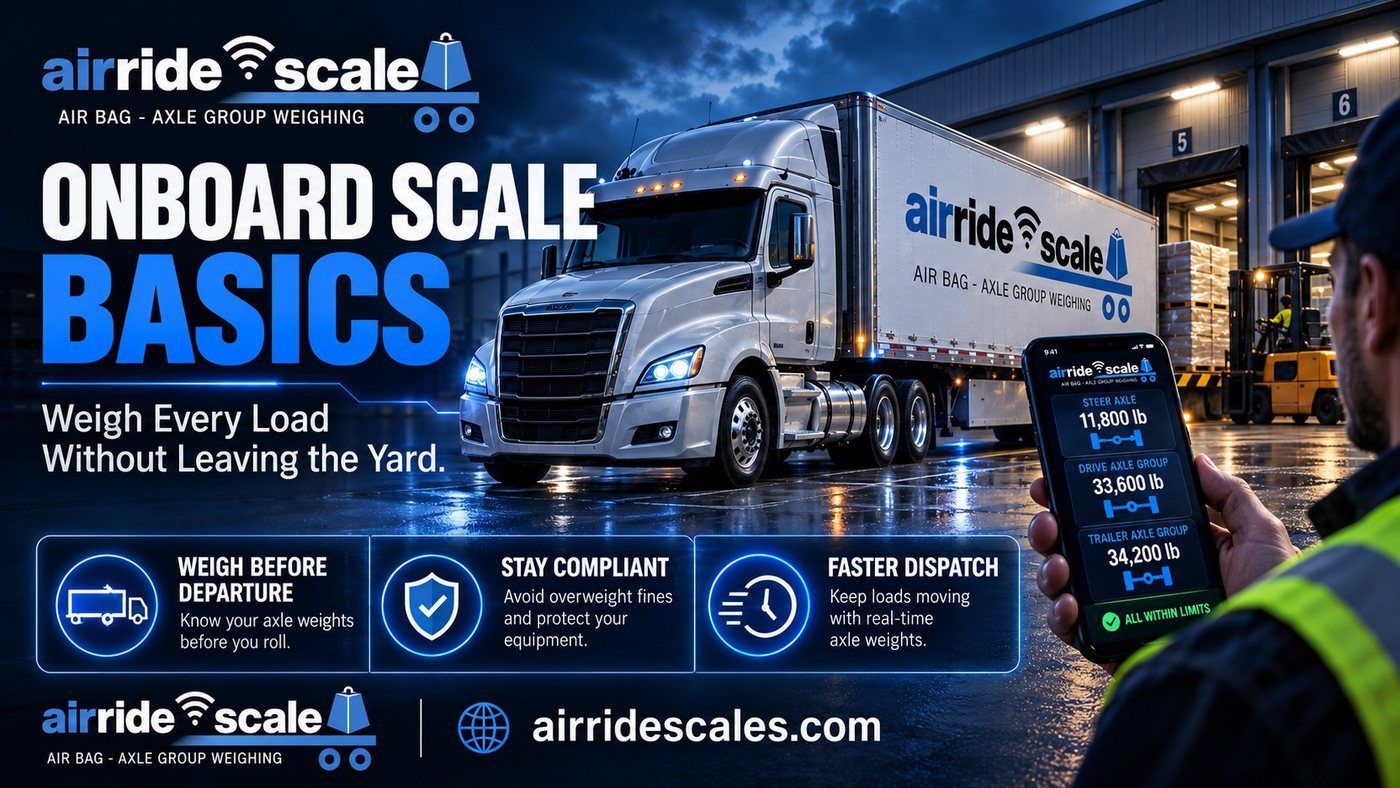
- A display, which on current systems is simply your phone: live weights per group, gross, and a legal limit status, in pounds or kilograms.
- Optional cloud reporting so dispatch and fleet managers see the same live picture across every unit.
What is deliberately missing from that list matters too: no in cab display to buy, no cables run through the chassis, no subscription required for the core job. The product page details the full architecture and the technology deep dive covers the engineering.
Why the location of the scale changes everything
A weighbridge answers after loading; an onboard scale answers during. That timing difference is the entire value. Watching the drive and trailer groups climb pallet by pallet means the load is built legal, not corrected later. A shipper pushing extra freight meets a live number instead of an argument. A tandem slide becomes a measured adjustment, the app showing the weight move between groups in real time, rather than a guess confirmed by a paid reweigh. Our guide to why drivers avoid scales shows the stress the old way creates; the onboard scale simply removes the reasons.
The one sentence pitch: an onboard scale turns every dock, yard, field and shed into a weigh station you never queue for and never pay.
Accuracy: the honest picture
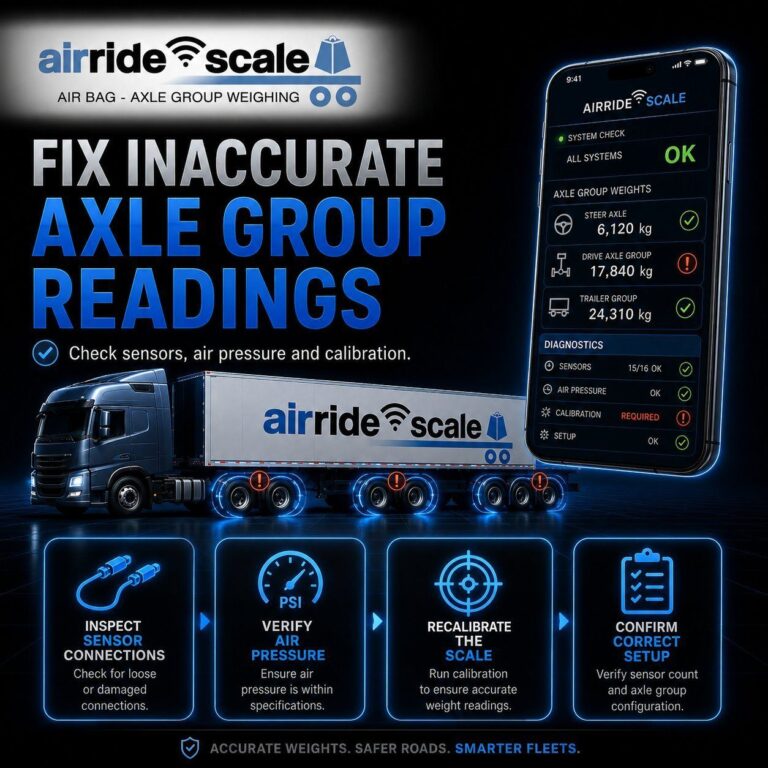
An onboard scale is a working tool, not a certified trade instrument, and the best vendors say so plainly. Calibrated properly against a certified weighbridge reference, an air suspension onboard scale delivers readings dependable enough to load to the legal limit with confidence and to catch an overweight group before enforcement does, which is the job. Accuracy is maintained by three habits: calibrate each axle group against a good reference, keep the air system healthy since a leaking bag skews its group, and weigh on reasonably level ground with the suspension settled. When a reading looks wrong, the troubleshooting sequence is sensors, air pressure, calibration, setup, in that order.
The payback arithmetic
Price the onboard scale against the habit it replaces. Public scale tickets run 13 to 15 dollars per weigh in the USA and comparable money in the UK and Europe. Add detour miles, queue time at peak hours, reweighs after adjustments, and the tail risk of an overweight citation with an out of service order, and a truck weighing twice a week quietly spends thousands per year answering a question its suspension could answer free. The complete calculation, line by line, is in our cost comparison, and for single truck operators the owner operator ROI guide runs the personal version. The pattern is consistent: regular weighers recover the system cost inside the first year.
Choosing well
The selection criteria compress to a short list: per axle group display rather than gross only, calibration you control from the app, RF wireless that holds signal across a full combination with up to 16 sensors, your phone as the display, sealed sensors built for life under a trailer, and no subscription gate on basic weighing. Our best onboard truck scales checklist expands each criterion, and the company evaluation guide covers the vendor behind the hardware.
Fit requirement: AirRide Scale weighs through the air springs, so every axle group you want to weigh must ride on air bag (air ride) suspension, the standard configuration for highway trucks and trailers across the USA, UK and Europe. Spring ride groups are not supported.
Getting started
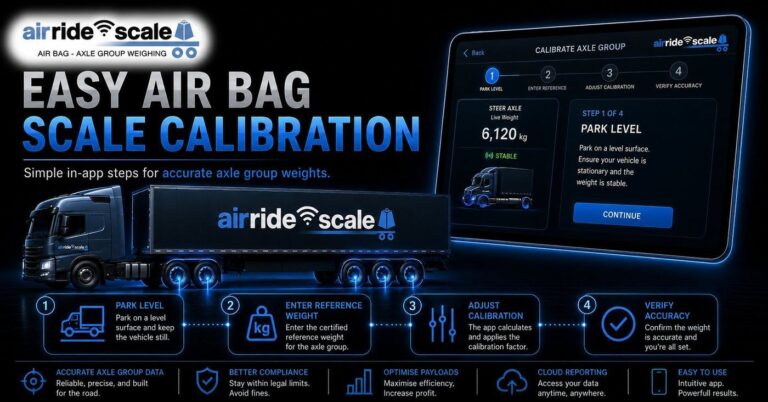
The retrofit is a same day job: sensors at each air bag, the Air Link powered, the app paired, each group calibrated against a known weight. Pilot one truck and trailer for a month, sanity check against a certified scale once, and let the vanished scale tickets make the fleet decision for you. Start at truck scales or trailer scales depending on where your weight problem lives, or ask us directly.
Onboard scales across the operation, not just the cab
The scale’s audience grows once it exists. Drivers use it to load and to pass inspections calmly. Loaders use it as a live target, building the stow right the first time. Dispatchers use the cloud view to confirm a unit is legal before it leaves and to answer customer weight queries without a phone chain. Maintenance quietly benefits too: because the readings come from suspension pressure, a group that starts reading soft or unstable is often announcing an air leak or a lazy levelling valve weeks before it becomes a roadside issue, making the scale an accidental health monitor for the air system. Even sales conversations change, since a time stamped weight from loading settles short delivery disputes in minutes. One retrofit, fitted in a day, ends up serving five departments, which is why onboard scales spread through fleets one convinced pilot truck at a time.
The bottom line: an onboard scale moves the answer from the weighbridge to the vehicle, from after loading to during, and from a recurring fee to a one time fit. For air suspension fleets, AirRide Scale is the cost effective way to make the move.