Air ride suspension weighing is the discipline of reading a vehicle’s load from its own suspension. Every truck and trailer on air ride carries the raw signal already: pressurised air bags whose internal pressure tracks the weight they support. The weighing part is the chain that turns that signal into a number a driver can act on, sensing, calibration, calculation and display. This article walks the full chain the way AirRide Scale implements it, then covers the factors that govern accuracy and the operational wins fleets report once the chain is in place.
Step one: the suspension does the sensing
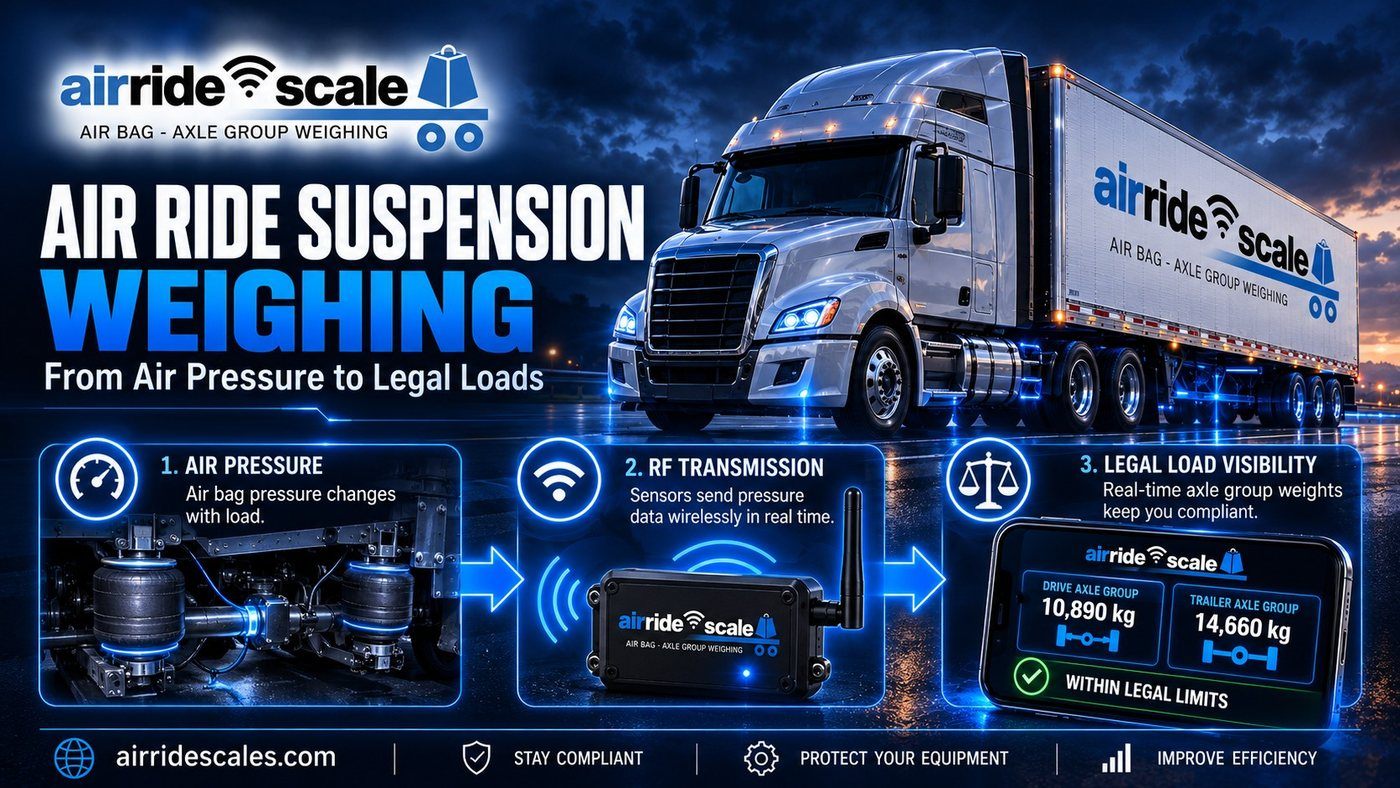
Air ride suspension holds the chassis at a constant ride height using one or more height control valves per axle group. Load the vehicle and the chassis dips; the valve adds air until the height recovers, leaving the bags at a higher pressure. Unload and the valve exhausts air. The result is a suspension that continuously balances pressure against load, which makes bag pressure an honest, repeatable proxy for the weight on that group. This is why air ride suspension weighing works where spring suspensions offer nothing to read: the air system is already performing the measurement, silently, all day. Our primer on why your tractor and reefer already contain a scale covers this foundation in plain language.
Step two: sensors capture the signal
AirRide Scale places a wireless RF sensor at each air bag position on the groups being weighed: steer, drives, and every trailer group. Groups with dual height control valves take a sensor per side so both circuits are read. The sensors sample pressure continuously and transmit by RF frequency, chosen over Bluetooth for its range across a full combination, its resilience around steel, and battery life measured in years. Up to 16 sensors report to one hub, enough for B doubles and complex multi axle rigs. The architecture choice is examined in RF versus Bluetooth air bag sensors.
Step three: calibration turns pressure into weight
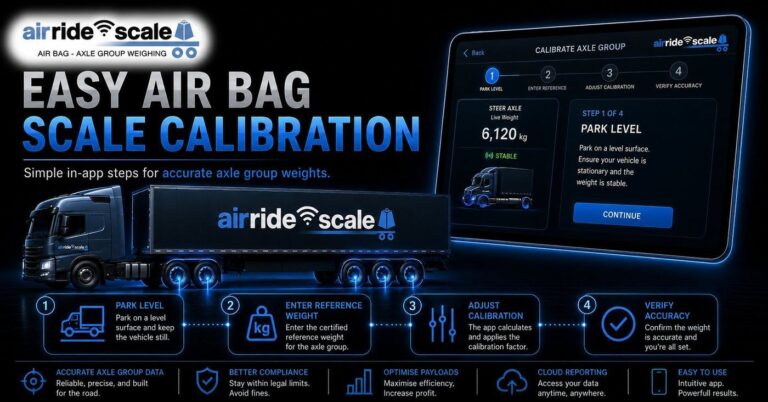
Raw pressure means nothing until it is anchored to reality, and the anchor is calibration. Park on level ground, let the suspension settle, enter a known weight for the group, ideally from a certified weighbridge ticket, and the system computes the relationship between pressure and weight for that specific group on that specific vehicle. Each group gets its own calibration because each carries differently. From that point the conversion is continuous and automatic. Calibration is also the owner’s lever on accuracy: recalibrate after air bag replacement or suspension work, and verify occasionally against a certified scale. The procedures are documented in the calibration guide and the reset walkthrough.
Step four: calculation and display
The AirRide Air Link hub gathers every sensor, applies each group’s calibration, sums the groups into a gross, compares everything against the legal limits you operate under, and sends the result by Bluetooth to the app on your phone. The display answers the three questions that matter in one glance: what does each group weigh, what is the gross, and is it legal. Units switch between kilograms and pounds in a tap, which earns its keep on cross border work, as the Canadian axle weights guide shows.
The chain in one line: suspension senses, sensors capture, calibration translates, the app answers. Remove any link and you are back to guessing; complete the chain and every load is weighed as it is built.
What governs accuracy in air ride suspension weighing
- Reference quality. Calibrate against a certified weight and the system inherits that quality.
- Air system health. A leaking bag or sticking levelling valve skews its group; the scale usually reveals the fault before the suspension complains.
- Ground and settling. Weigh level, with the suspension settled, the way you calibrated.
- Configuration. Sensors assigned to the right groups, lift axles in a consistent position.
Respect those four and the readings stay dependable load after load; neglect them and the troubleshooting guide will walk you back.
What fleets actually gain
The operational wins repeat across markets. Loads built to the legal limit instead of under it, which is pure recovered revenue. Distribution corrected at the dock while the forklift is still present, the difference our reefer distribution guide quantifies. Public scale spend collapsing to an occasional calibration check. Inspection stations approached with knowledge instead of hope. Even maintenance benefits: balanced loads wear tyres, brakes and suspension evenly, and the pressure readings themselves flag air system faults early.
Scope, stated plainly: air ride suspension weighing requires air ride suspension on each axle group you weigh. It is a compliance and loading tool, not a certified trade scale, and within that scope it is the most cost effective weighing a highway fleet can own.
Putting it on your vehicles
Fitting is a same day retrofit covered in the installation guide: sensors, hub, app, calibration. The truck scales and trailer scales pages cover the tractor and trailer sides respectively, and the FAQ answers the common questions.
A worked example, dock to highway
Picture a reefer loading mixed grocery at a US distribution centre. Empty, the app shows the knowns: steer around 11,600 lbs, drives light, trailer group carrying its tare. As pallets board, the loader watches the trailer group climb and the drives rise in sympathy through the kingpin. Two thirds in, the drives are trending toward 33,000 lbs while the trailer group has headroom, so the heavy drink pallets move two positions rearward and the split corrects on screen in real time. Doors close with every group inside its limit and 3,000 lbs of legal capacity deliberately held back for reefer fuel and the unknowns of a three stop route. At the state scale an hour later, the in ground reading matches the app within the tolerance the driver has learned to expect, and the truck rolls through without a second glance. Nothing in that sequence required a ticket, a queue or a guess, which is the entire argument for completing the chain.
The bottom line: air ride suspension weighing completes a measurement your suspension already half performs. AirRide Scale supplies the missing half: sensors, calibration and a live answer on your phone, for every load, in the USA, UK, Europe and beyond. Talk to us about your fleet.