Every onboard scale promises the same outcome: know your weight without the weighbridge. The best onboard truck scales actually deliver it, every load, for years, without a subscription ambush or a dead display in month fourteen. The difference between great and gimmick is visible before you buy if you know which features carry the outcome and which are decoration. This is the feature by feature checklist we would use ourselves, and yes, we build one of the contenders, so judge AirRide Scale against it too.
Feature one: axle group detail, not just gross
The single biggest divider. Enforcement in the USA, Canada, the UK and Europe weighs by axle group: the steer, the drive tandem, each trailer group. A gross only reading can show a legal total while a group sits over its limit, which is precisely how clean looking loads collect fines. The best onboard truck scales display every group simultaneously, because balance is a relationship between groups and you cannot manage a relationship you can only half see. Our US axle limits guide shows the numbers that make this non negotiable.
Feature two: calibration you own
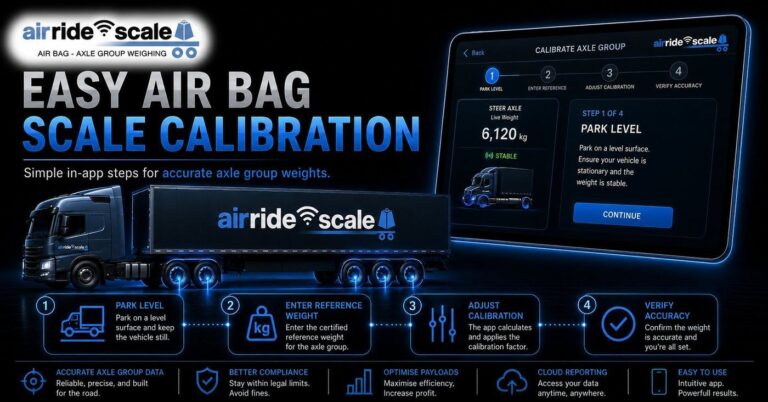
Accuracy on an onboard scale comes from calibration, so ask who controls it. The best systems let you calibrate in minutes, per group, against a certified weighbridge ticket, from the app, with the result stored on your device. Systems that require a service visit for calibration turn every suspension repair into a scheduling problem and every drift into downtime. AirRide Scale puts the whole procedure in the app, documented in our calibration guide, with a clean reset available when you want a fresh baseline.
Feature three: wireless that survives a real combination
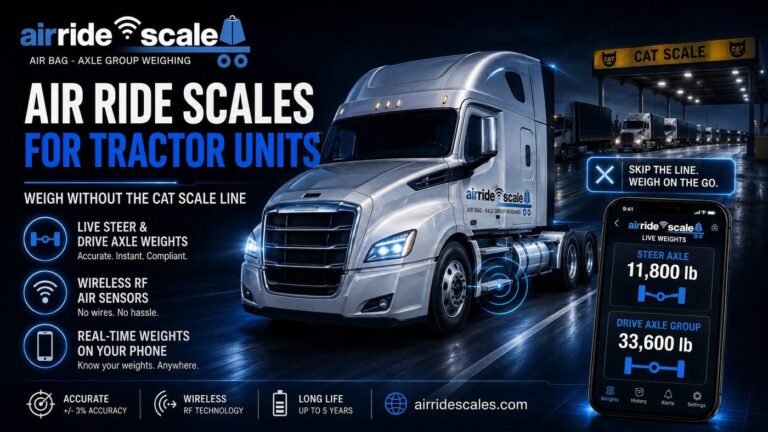
A tractor and trailer is fifty plus feet of steel, and sensor signals must cross it reliably with the reefer running and the yard full of interference. This is where sensor radio architecture decides everything. Bluetooth sensors pair conveniently but fade with distance and limit sensor counts. RF frequency systems, the architecture AirRide uses between sensors and hub, hold signal across the full length, support up to 16 sensors, and run years on their batteries. The hub then speaks Bluetooth only for the final short hop to your phone. The full comparison is in RF versus Bluetooth sensors, and it is the question we would ask any vendor first.
The demonstration that matters: ask to see live readings from the rearmost trailer group while standing at the cab. A system that passes that test in a crowded yard will pass it on the road.
Feature four: the display you already own
Dedicated in cab displays were once the only option. Today they are mostly a cost and a failure point: hundreds of dollars of hardware doing what a phone app does better, with no updates and no portability between vehicles. The best onboard truck scales treat the smartphone as the display, iOS and Android, with units switchable between pounds and kilograms for cross border work. The money saved on screens goes into the parts that matter, sensors and calibration quality.
Feature five: fleet visibility without lock in
For fleets, the step beyond the cab is dispatch seeing what the driver sees. Cloud reporting that shares live weights and compliance status across the fleet turns the scale from a driver tool into an operations tool, catching an overloaded unit in the yard rather than on the interstate. The test is whether the core weighing works without any subscription: on the best systems, including AirRide Scale, cloud visibility is an option on top of a complete product, never a toll gate in front of it.
Feature six: durability where the sensors actually live
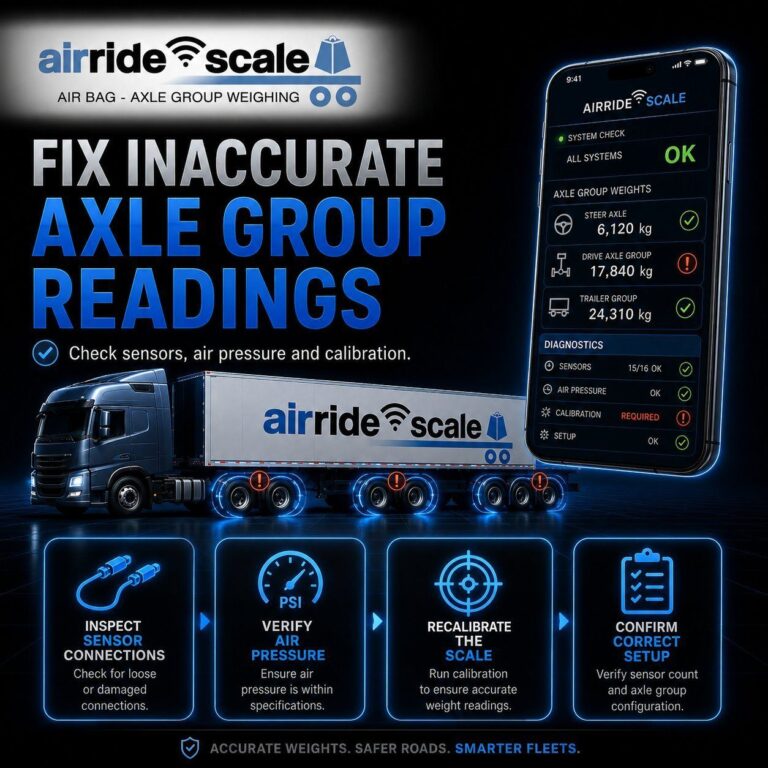
Sensors mount at air bags, inches from winter road spray. Great systems use sealed units rated for exactly that life, with batteries measured in years and diagnostics in the app that name a dropped sensor instantly, as covered in our troubleshooting guide. Ask any vendor for sensor sealing details and replacement pricing, because a bargain system with fragile sensors is an expensive system on a two year view.
The scoring shortcut
- Per axle group display including gross and legal status: essential.
- Owner calibration from the app in minutes: essential.
- RF sensor architecture with 12 to 16 sensor support: essential for combinations.
- Phone as display, lbs and kg: strongly preferred.
- No subscription for core weighing: strongly preferred.
- Sealed sensors with multi year batteries and app diagnostics: essential.
Score candidates against that list and the field narrows fast. AirRide Scale is built to tick every line, which you can verify on the product page and challenge through the FAQ.
One scope note: AirRide Scale is an air suspension system, so it suits trucks and trailers with air bag suspension on each weighed group, the configuration most highway fleets already run. Spring ride equipment needs a different technology, and an honest vendor says so.
Proving it before you commit
However good the checklist result, pilot before rollout: one truck and trailer, fitted in a day, weighed on every load for a month, sanity checked against a certified scale once. The best onboard truck scales make the decision for you inside that month, because the scale tickets stop and the anxiety at inspection stations goes with them. Start with our onboard truck scales overview, then arrange a pilot unit.
Where systems quietly fail, and how the best ones do not
Most onboard scales look identical in a demo. The separation happens in the ugly weeks: February slush burying the trailer sensors, a yard with forty trucks and their interference, a driver who skipped the manual, a suspension repair that silently invalidated a calibration. The best onboard truck scales anticipate each failure: sealed sensors shrug off the slush, RF holds signal through the crowded yard, the app is simple enough that the manual is optional, and recalibration after repairs takes five minutes because the owner controls it. Build your pilot month to include the ugly cases deliberately. Park the test unit at the far end of the yard and check signal. Weigh on the sloped dock as well as the flat one. Let your least technical driver run the app unaided. A system that passes the hostile version of the pilot will pass the next five years.
The bottom line: the best onboard truck scales share a shape: group level detail, calibration in your hands, RF range that covers the whole rig, your phone as the screen, and hardware built for the underside of a trailer. Hold every candidate to that shape, ours included.